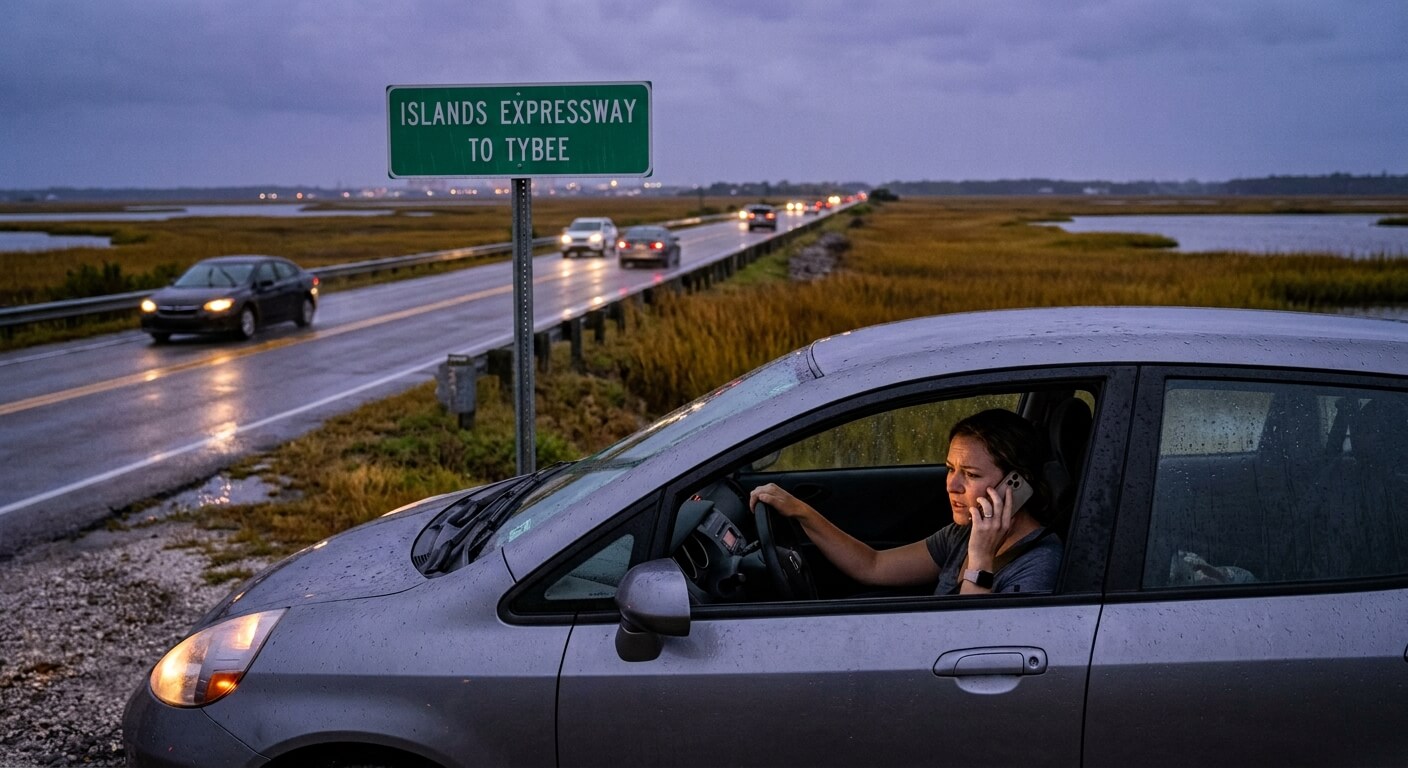
The Anxiety of Being Stranded on the Road in Savannah
Nobody is ever ready for it. That’s the thing about breaking down — it doesn’t give you a warning, doesn’t pick a convenient moment, doesn’t wait until you’re somewhere sensible with plenty of time to spare. It just happens, usually in the middle of something else entirely, and the first few seconds after it does are almost always the same: a strange, suspended moment where your brain is still catching up to what just occurred.
Then the feeling sets in.
Being Stranded on the Road Is Not Just Stress. It’s a Specific Kind of Helplessness.
There’s a particular texture to the anxiety of being stranded that’s different from ordinary stress. It’s not the anxiety of a hard conversation or a looming deadline — those feel like pressure building toward something. Being stranded feels more like the ground disappearing. One moment you were in control of where you were going and when you’d get there, and the next moment you aren’t, and there’s nothing immediately obvious you can do to change that.
For a lot of people, that loss of control is the hardest part — not the inconvenience, not the cost, not even the wait. Just the sudden, jarring shift from being a person going somewhere to being a person stuck somewhere, in a car that isn’t moving, while the rest of the world drives past.
Why Breaking Down in Savannah Adds Its Own Layer
Every city has its own version of this experience, and Savannah’s is shaped by the geography and the climate in ways that make an already uncomfortable situation feel more acute.
If you break down on Islands Expressway on the way to Tybee, you’re on a narrow road flanked by marsh on both sides, with beach traffic flowing past and almost no shoulder to speak of. The isolation of it — surrounded by water and grass with nowhere obvious to go — has a way of making the situation feel more remote than it actually is. Your phone signal may be inconsistent. The cars going past aren’t slowing down. The marsh doesn’t care.
If you break down in the historic district, the problem is different but equally disorienting. The one-way streets and square grid, which feel charming and navigable when you’re driving normally, become a small puzzle when you’re standing next to a car that won’t move and trying to describe your exact location to someone on the phone. Tourists walk past. A horse-drawn carriage circles the square. You’re standing in one of the most photographed cities in the South, and somehow that makes it lonelier, not less.
And if it happens in summer — which in Savannah covers an uncomfortably large portion of the year — there’s the heat to contend with too. Sitting in a car on the side of a road with the engine off and the AC no longer running, in July, is its own kind of misery that compounds everything else happening.
Waiting for Roadside Assistance Is the Hardest Part
Most breakdowns, objectively, are temporary. The car will get fixed. You’ll get where you’re going, eventually, or you’ll make new plans. The practical disruption of a breakdown, in the long run, is usually manageable.
But the wait doesn’t feel managed. It feels open-ended in a way that’s disproportionate to what’s actually happening. Studies on stress and uncertainty consistently find that the not-knowing — not knowing how long, not knowing exactly what’s wrong, not knowing whether help is really coming — is harder on people than the event itself. A breakdown you knew would be resolved in exactly twenty-two minutes would feel completely different from one where you’re sitting there at the fifteen-minute mark wondering if you gave the right address.
That uncertainty is what accumulates. What starts as surprise shades into frustration, and frustration into something quieter and more draining — a low hum of helplessness that sits there for the entire duration of the wait, no matter how reasonable the wait actually is.
What Usually Helps While Waiting for a Tow
Not fixes — nothing fixes it except help actually arriving. But a few things genuinely make the wait more bearable.
Knowing that someone is coming, and roughly when, takes a significant amount of the edge off the uncertainty. It doesn’t change the physical situation, but it changes the psychological one considerably — the open-ended wait becomes a finite one, and finite things are much easier to sit with than open-ended ones.
Staying in the vehicle, if it’s safe to do so, helps more than it sounds like it should. There’s something about remaining inside the familiar space of your own car — even a car that isn’t working — that’s more grounding than standing outside next to it, exposed, watching traffic.
And telling someone where you are — a friend, a family member, whoever — helps with the isolation more than most people expect. Not because they can do anything about it necessarily, but because being stranded feels private and invisible in a way that a quick text or call can partly undo.
You’re Not Overreacting
This is worth saying plainly: the anxiety of being stranded is a real, documented stress response to a genuine loss of control, in a situation that often involves physical discomfort, time pressure, financial uncertainty, and a degree of safety risk. Feeling genuinely unsettled by it isn’t weakness or a disproportionate reaction — it’s a normal human response to an objectively uncomfortable situation.
Most people feel it, even people who handle it calmly on the outside. The driver who pulls over without visible panic, calls for help efficiently, and waits patiently is often just someone who has learned to manage the feeling, not someone who isn’t having it.
How On Point Towing and Roadside Fits Into All of This
When an On Point Towing and Roadside operator arrives at your window, they’re not just there to move a vehicle. They’re arriving at the end of however long you’ve been sitting there — with whatever that wait has done to your mood, your patience, and your composure. The fastest way to make that better is just to show up quickly, explain clearly what’s happening, and get the job done without adding any new complications to a day that already has enough of them.